
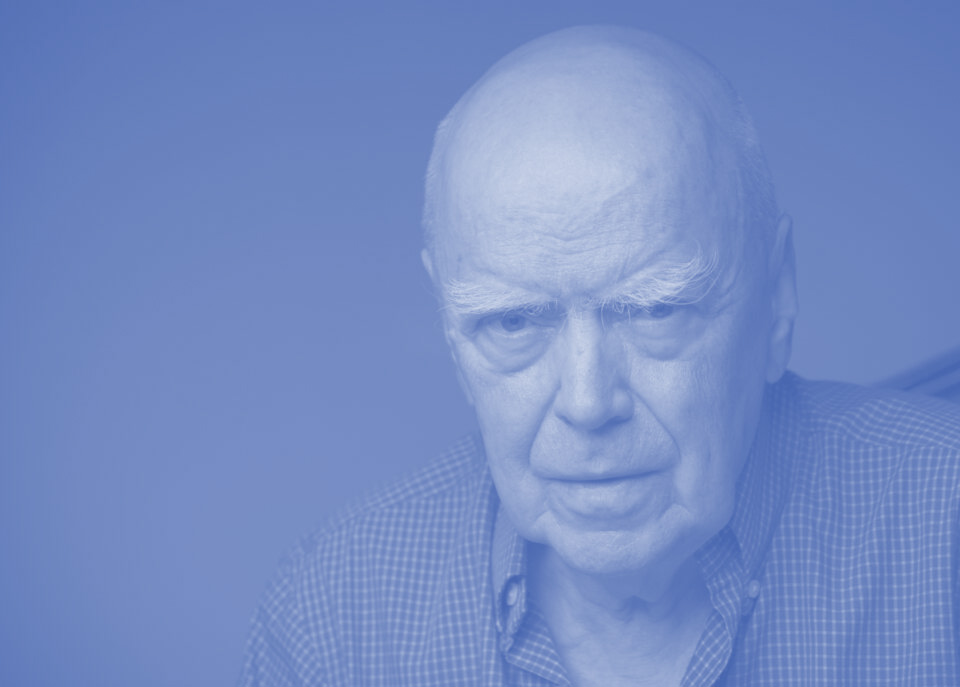
Marek
Rymkiewicz
His every book or even speech aroused heated discussion.

Born in 1935 in Warsaw, he was first recognized at 22 for his poetry volume Conventions, published in Łódź. In 1967 he announced his literary creed in the book Czym jest klasycyzm. Manifesty poetyckie. [What is Classicism. Poetic Manifestos.]. The author of many collections of poems, the best known being: Thema regium (1978), Ulica Mandelsztama [Mandelstam’s Street] (1983), Moje dzieło pośmiertne [My Posthumous Work] (1993), Znak niejasny, baśń półżywa [The Sign Unclear, the Fable – Half-Alive] (1999), Zachód słońca w Milanówku [Sunset in Milanówek] (2002), Wiersze polityczne [Political Poems] (2010), Pastuszek Chełmońskiego [Chełmoński’s Shepherd Boy] (2014) and, published in 2015, Koniec lata w zdziczałym ogrodzie [The End of Summer in a Garden Gone Wild]..
His two novels, written in the eighties and published underground: Rozmowy polskie latem 1983 [Polish Conversations in the Summer of 1983] (1984) and Umschlagplatz (1988), attracted a great deal of interest from readers and have been translated into French, German and English.
Rymkiewicz included the results of his vast work as a literature historian in his volumes of essays and encyclopedic writings, devoted to Mickiewicz, Słowacki, Leśmian and Fredro. He worked in the Literary Research Institute of the Polish Academy of Sciences, from where he was dismissed in 1985 (employed again after 1989). In 1994 he was awarded the title of Professor of Humanities.
In the first decade of the 21 C, he wrote his famous historical essays: Wieszanie [The Hanging] (2007), Kinderszenen (2008), Samuel Zborowski (2010), Reytan. Upadek Polski [Reytan. The Fall of Poland] (2013). A lot of valuable thought he left in his 1983 essay Wielki Książę z dodaniem rozważań o istocie i przymiotach ducha polskiego [The Grand Duke, With Some Musings on the Essence and Virtues of the Polish Spirit]. (1983).
Author of dramas and comedies, almost incessantly played in the National Theatre since the 60-s; his Ułani [The Lancers],(directed by Piotr Cieplak) are still on nowadays.
He translated a lot of world literature into Polish, among others the poetry of Thomas S. Eliot and Wallace Stevens, Osip Mandelstam, Federico García Lorca and of the dramas of Calderón de la Barca. He lived many years in Milanówek, which he loved and where he died on February the 3 rd , 2022.
For his work he was rewarded numerous awards, among others: The Kościelski Award (1967), Stanisław Vincenz Award (1984), Zygmunt Hertz Award (1986), Nike Award (2003), and in 2015: Julian Tuwim Award as well as the Literary Award of Warsaw, of which the latter he refused to accept for political reasons. In 2016 he was awarded the Lech Kaczyński Award. In 2022, the Parliament of the Republic of Poland – in a resolution adopted by acclamation on 9 February – commemorated the poet and recalled his outstanding creative output.
„Classicism is the unceasing fight for your place in culture, and thus also in the present time, it is an unceasing awareness that the past is present, it is the awareness that there is no poetical idiom of the past or of the present, because there is one great sea of poetic language beyond time, finally, it is the unceasing projection of oneself and others onto the future.”
Sądy, przesądy – w powiększeniu: Rymkiewicz
[Judgments, prejudices – under magnifying
glass: Rymkiewicz]
Rymkiewicz. Historia i metafizyka
[Rymkiewicz. History and Metaphysics]
Poeta pozwany
[The Poet Sued]